What is a PEFCR?
A Product Environmental Footprint Category Rule (PEFCR) is a set of product-group-specific rules that defines how the environmental footprint of a product in that group must be calculated under the EU Product Environmental Footprint (PEF) method. A PEFCR fixes the functional unit, the system boundary, the life cycle stages, the data quality requirements, the default datasets and the impact assessment method (the Environmental Footprint method, EF 3.1), so that two products in the same group can be compared on the same basis. The PEFCR for apparel and footwear is developed by a technical secretariat under the guidance of the European Commission.
The gap between "aligned" and "compliant"
A vendor that writes "PEFCR compliant" on its website today makes a claim that cannot be substantiated. A textile SME should treat such a claim as a warning sign, not as a credential.
Why the PEFCR matters for a textile SME
The PEFCR will become the reference method for product-level environmental claims in the EU. It connects to three instruments a textile company already faces.
- ESPR (Reg. EU 2024/1781) sets ecodesign requirements per product group. The methodology for environmental performance information in the textile delegated act is expected to draw on the PEF work.
- Digital Product Passport, expected to apply 18 months after the textile delegated act (expected Q4 2027), will carry environmental data. The method behind that data must be stated.
- Empowering Consumers Directive (Dir. EU 2024/825) prohibits generic environmental claims that are not substantiated, applicable from 27 September 2026. A product-level method with a stated scope is the substantiation.
A company that already works with product-level LCA data in the ISO 14040/14044 structure will find the transition to the EF method a change of characterisation method and datasets, not a change of practice.
What alignment looks like in practice
The last row needs attention. EF 3.1 includes toxicity categories. The PEFCR may require them. Current textile chemical data does not support a reliable toxicity result: formulations are undisclosed and safety data sheets are incomplete. A careful platform excludes toxicity today, says so, and will include it under the EF method once PEFCR data requirements make it defensible.
What a textile SME should do now
- 1Start product-level assessment now with a method that states scope with every result. Do not wait for the final PEFCR.
- 2Build the primary data relationship with suppliers of the hotspot processes. PEFCR data quality requirements will reward primary data.
- 3Keep results per supply chain step so they can be mapped to PEFCR life cycle stages later.
- 4Avoid the word "compliant" until the Commission adopts the PEFCR.
Where bAwear Score fits
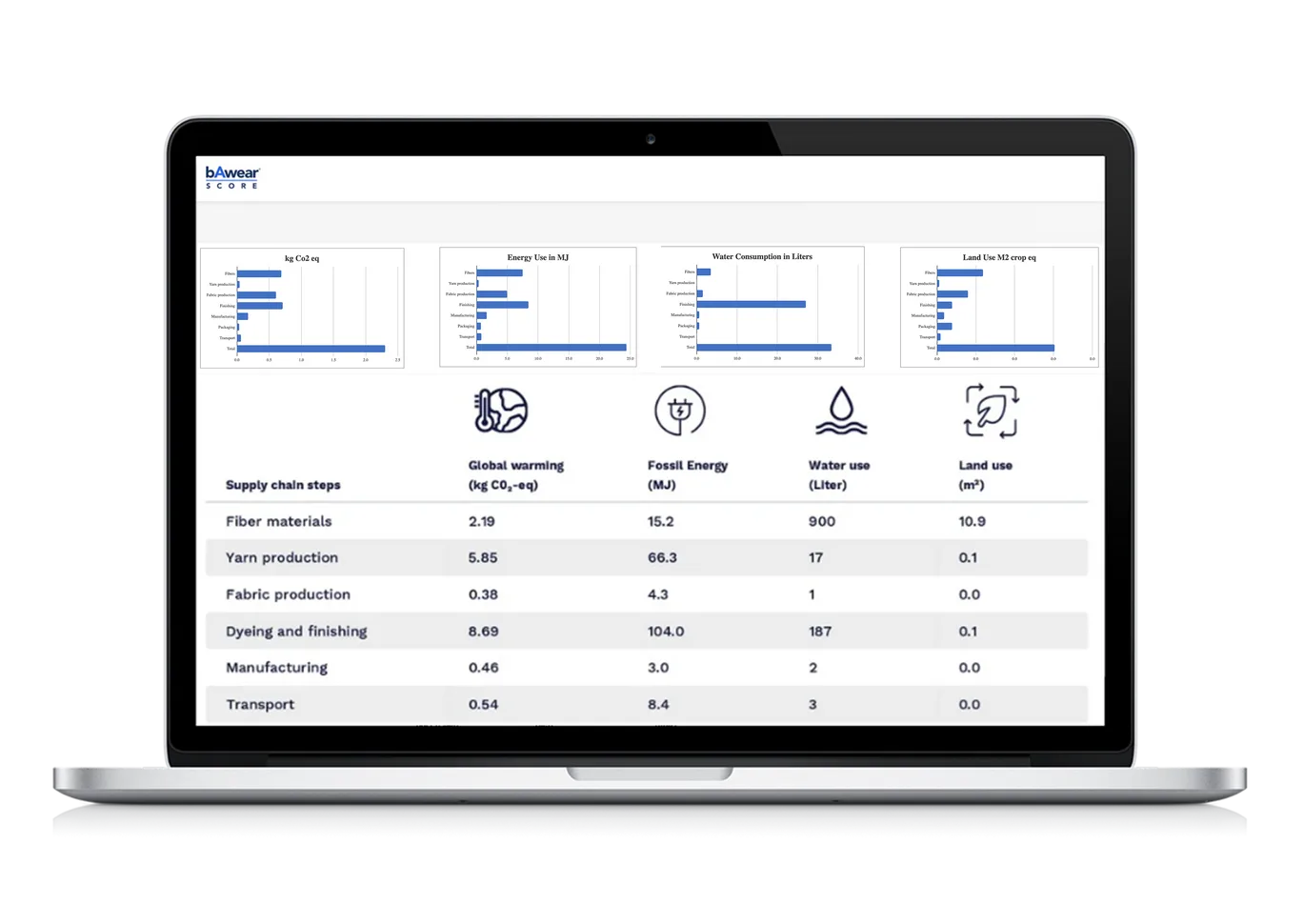
bAwear Score is an LCA-based environmental impact measurement platform for the textile and apparel industry, built by bAwear B.V. in the Netherlands and powered by SimaPro. It is built in the direction of the EU textile regulatory framework, including ESPR, the Digital Product Passport, CSRD and the PEFCR for apparel and footwear. It applies ReCiPe 2016 Midpoint (Hierarchist) in line with ISO 14040/14044 and reports global warming (kg CO₂-eq), fossil resource use (MJ), water use (L) and land use (m²), per supply chain step, across cradle-to-gate or cradle-to-grave, with 1 kg of textile product as the standard functional unit. Chemical and human toxicity are excluded by design until PEFCR data requirements are in place, at which point bAwear intends to move to the EF method. bAwear Score does not claim PEFCR compliance, because no solution can.
Quick Score results are indicative and intended for internal decision support and reference product comparison. They do not replace a full ISO 14040/14044 LCA with critical review.
Frequently asked questions
- 1European Commission, Product Environmental Footprint (PEF) method, Recommendation (EU) 2021/2279
- 2European Commission, PEFCR Apparel and Footwear (draft, under development)
- 3Regulation (EU) 2024/1781 (ESPR)
- 4Directive (EU) 2024/825, Empowering Consumers for the Green Transition
- 5ISO 14040:2006 and ISO 14044:2006